 Completed
Palermo historic centre, four mandamenti districts · 2012–2013
- Project published
- July 2012
- Survey results
- February 2013
- Designer
- arch. Michelangelo Pavia
- Contributors
- Lucrezia Mannino, Giuseppe Castellucci, Alice Franchina, Luisa Tuttolomondo, Marco Fuscaldo
- Survey partner
- Associazione Semenza — semi per la mente e per la cittadinanza
- Area
- Palermo's historic centre, four mandamenti districts (~22,000 residents in the First District)
- Survey responses
- 280 people, 65% men / 35% women, 77% aged 18-45, 43% living in the historic centre
- Support for pedestrian routes
- 66% fully in favour + 28% in favour under conditions = 94%
Percorsi Palermo · microinterventi di ricucitura del tessuto urbano
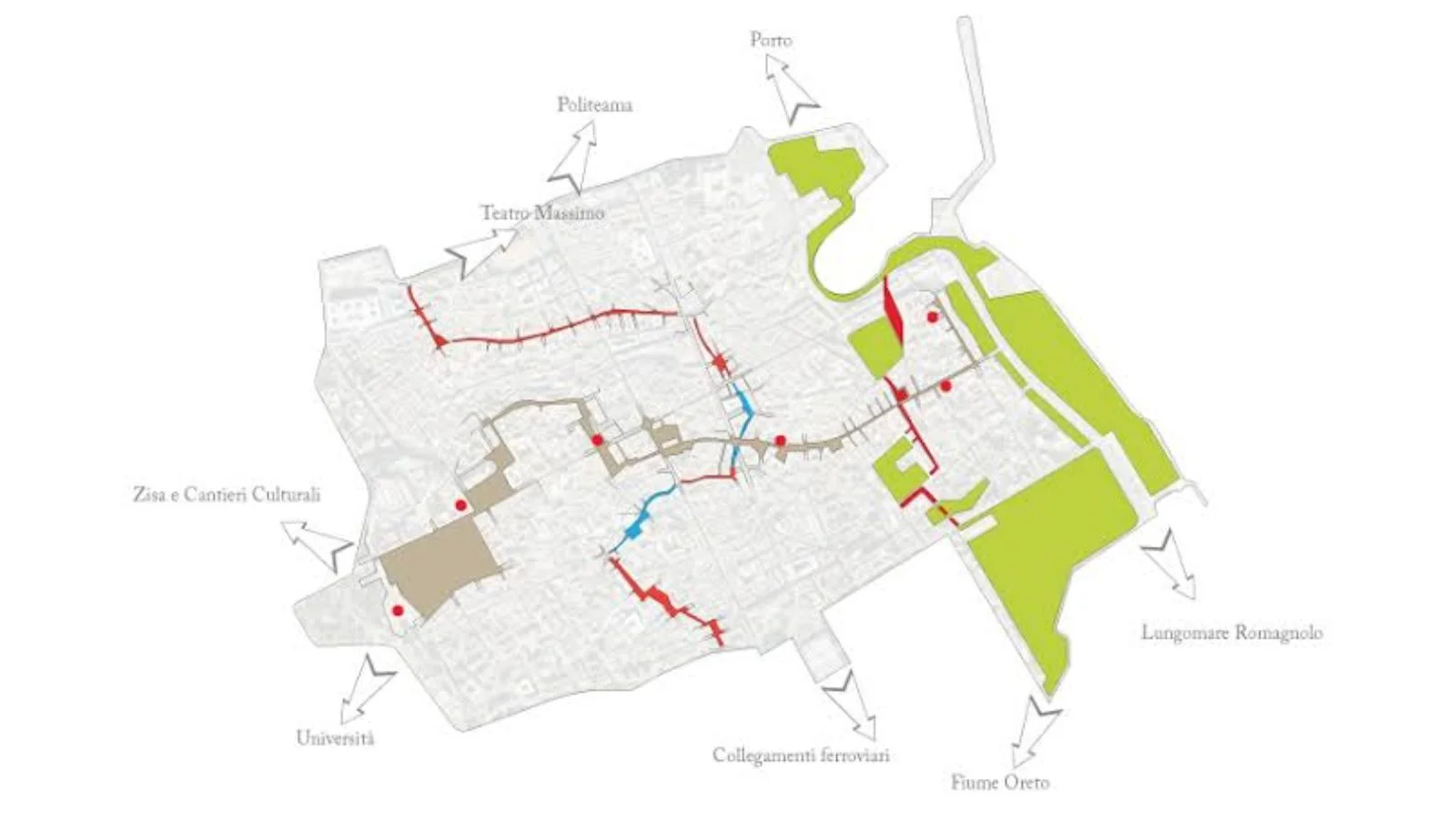
Percorsi Palermo is the urban planning project through which, in 2012, we proposed three thematic pedestrian routes to reweave Palermo's historic centre — a markets route, a museums route, a greenery route — linking physical space to a participatory virtual space. A public survey collected 280 responses, confirming that 94% of respondents wanted more pedestrian space.
Percorsi Palermo started in July 2012 out of an idea by architect Michelangelo Pavia, developed inside the neu [nòi] coworking together with a group of members — Lucrezia Mannino, Giuseppe Castellucci, Alice Franchina, Luisa Tuttolomondo, Marco Fuscaldo. It starts from a personal observation: Palermo, like Lisbon, tells its story to whoever crosses it through memory and place. From there came the idea of three thematic pedestrian routes crossing the four mandamenti of the historic centre, linking a physical space with a virtual space for participation and technological governance at the same time.
The markets route highlights Ballarò, Vucciria and Capo — the three historic food markets — alongside via Bandiera (textiles) and via Calderai (tinware). The proposal includes two stitching interventions: a new market area with an ethnic character on via Casa Professa, next to Ballarò, designed for the neighbourhood's African and Indian communities; and a showcase for provincial craftwork on piazza Borsa, echoing the old Arab lattarini market (suk el attarin), with bookable, rotating stalls.
The museums route proposes pedestrianising the east-west axis from Porta Felice to Palazzo dei Normanni, to create a "diffuse museum" linking the Museo Internazionale delle Marionette Antonio Pasqualino, Palazzo Abatellis, the GAM, Palazzo Riso and the Cappella Palatina — heritage that, the project argues, suffers from outdated management and a lack of collaboration between institutions.
The greenery route connects the coastal areas of Foro Italico, Villa Giulia and the Orto Botanico, aiming to turn piazza Magione into an open-air gym and introduce an annual fitness festival along the coast.
Each route comes paired with a "virtual space" proposal — geolocation, information kiosks, booking portals, citizen feedback — designed to make even small physical interventions more visible and participatory.
In September 2012, together with the Semenza association, we ran a public survey to test the idea. The results, published in February 2013, gathered 280 responses: the sample was 65% male, 77% aged 18-45, with 43% living in the historic centre and 48% living elsewhere in the city. On the key question — "do you like the idea of creating pedestrian routes?" — 66% answered "yes, absolutely," and a further 28% "yes, under certain conditions": 94% overall support. Among the themes that came through most strongly in the open answers: traffic and the lack of public transport, noise pollution, deteriorating heritage, and — a need the original project hadn't anticipated — bike lanes and bike-sharing, strong enough to push us toward imagining a fourth route dedicated to bicycles.
Percorsi Palermo was published free of charge, as a contribution to the city's debate on the need for urban planning with clear goals and a real listening process. It's the first real laboratory of the participatory methodology we'd later bring to Verso La Favorita, to the process behind the Regolamento sui Beni Comuni, and, more than ten years on, to Orbita.